With Limited Supply Chain Access Small Businesses Face Different Design Challenges
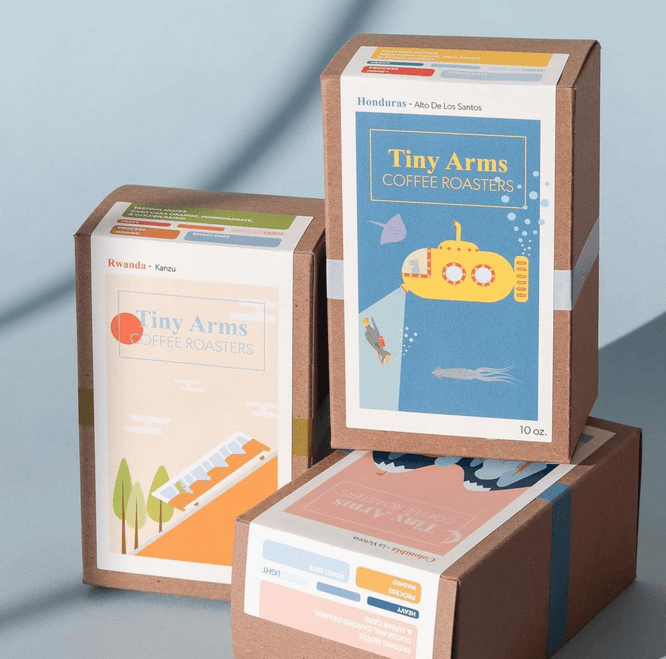
Tiny Arms Coffee original kraft board packaging with label acting as brand and seal
The supply chain has impacted all types of businesses, large and small. The costs of raw goods have increased, and inflation has hit 7.9%. This puts new pressure on all business owners – especially small yet growing businesses
Design Changes Impacted by the Supply Chain.
Supply chain issues have forced small businesses to shift their thinking and approach to the form and function of their packaging design. An excellent example is Tiny Arms Coffee, a small coffee roaster in Lowell, Massachusetts. Their original packaging was on craft recycled boxes, with a label affixed to the top to seal the package. The labels are bold, colorful, and fun. John Santos, the owner, shared that it took him and his wife 11-steps to complete a final package, including folding, filling, and labeling. Their current labels were ordered in minimum quantities, but rising paper costs were eating into their margins. When it was time to re-order packaging, the company was faced with a dilemma. Stay with their current packaging or look for more cost-effective alternatives and redesign. Tiny Arms Coffee chose to move to a plastic package. While plastic packaging did not align with is not in line with their core values.
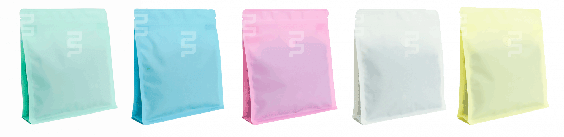
Dutch Coffee Pack's new single use plastic flat bottom packaging in pastel colors.
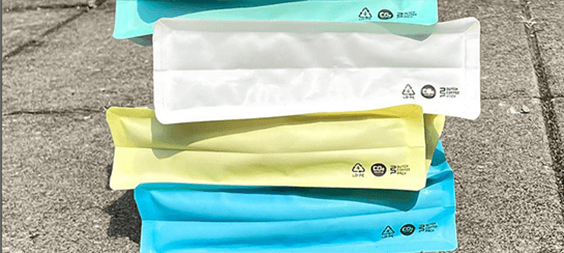
The Dutch Coffee Bags are a mono-material plastic.
Supplier Considerations.
When evaluating new packaging designs, Tiny Arms Coffee looked for a compostable package with a valve to increase shelf life. There were no viable solutions on the market. As the company learned, even though a product has a recycle symbol, it may not be easily recyclable. Compostable bags can be recycled, but the valve, made of a separate plastic, is not, which places ownership on the consumer to disassemble it to correctly recycle the package.
Instead the small business owners selected a flat bottom pouch made by Dutch Coffee Pack. The Dutch Coffee house flat bottom coffee bag is made of a single PE plastic, PE, certified under European standard DIN EN 13430, the latest recycling standards. Dutch Coffee House was also the first packaging company to metallization in its packages.
The original Tiny Arms Coffee labels were vertical. This new package required investment in redesigning its label to support the horizontal design. With new packaging and labels, Santos said, the company donated its old, unused packaging – over 2,000 empty boxes.
For the owners, it was a hard and complicated decision. One they did not want to embark on, but needed to as market dynamics shifted.
Illustration of Dutch Coffee Pack's new single use plastic flat bottom packaging.
Tiny Arms Coffee's new single use plastic packaging design.
Tiny Arms Coffee's new packaging design presented on the shelf.
Design Changes.
When small businesses engage a designer or agency, it is typically for a brand and packaging design. With today’s supply chain issues, designers need to be thoughtful in how their design may have to shift with changes in the shape and form of the package and label.
When designing labels and packaging, both business and designers should consider the following:
Material Costs – Material costs are increasing, and some materials have become difficult to source. Pulp paper is at an all-time high, raising costs for small businesses. Taking into consideration that access to these materials may change. Your design may need to work across multiple materials with minimal changes.
Volume – What is the minimum order size allowed by manufacturer of your packaging – boxes, bags, etc. Depending on your volume, some packaging options may not be viable. One example is craft brewers, with their fun and cheeky labels. Ball Corporation, a US-based cans manufacturer, has changed its minimum order quantity five-fold. Ball’s new minimum order shifted from one truckload, per SKU for printed cans, which equates to about 200,000 cans — to five truckloads, or roughly one-million cans. Craft brewers who work in cans and labels are now delaying new releases and raising pricing. Craft brewers make up 3% of the market, and each craft brewery produces less than 6 million barrels a year. Ball Corporations’ new minimum order makes it nearly impossible for micro-brewers to place orders., Craft breweries will need to take on an enormous amount of inventory and risk to meet the minimum order requirement. This will change how these small businesses work with their supply chain.
Shape – Just like Tiny Arms Coffee, shape and form factors are vital to a packaging experience. Today’s new pouch designs and boxes offer new form factors for designers to consider. However, designers need to consider both shelf and e-commerce for their designs. Both the shelf appeal and at home unboxing experience need to be well designed for an optimal consumer experience.
Shipping – The US Postal Service and other carriers have increased shipping costs. Small business can’t afford to offer free, two-day shipping, and shipping a package across the US can cost $10-$15. Many small businesses even lose money on shipping. Packaging designs need to factor in weight of materials, durability, and how the package (or multiple items) fits into standard shipping boxes. A customer may order one item or a dozen, and creatives should be thinking how to design for the bulk that is optimized for shipping. Some small businesses may have to give up margins to work with third party logistics partners (3PLs) to manage their inventory across a region to help reduce shipping costs. 3PLs, co-packers and other partners may have specific requirements that dictate packaging designs.
Nimble Design.
Today’s small brands are forced to make complex business decisions. This means designers need to be nimble in their approach and thinking. There are many channels’ consumers engage with, both online and digitally, and designers should consider that in their process for package design. For example, a label may be used to digitally express or present a package to the consumer online, but shipping and unboxing should be considered. If a business can’t access the materials for production, what are the alternatives, and does the design support those production alternatives. Being empathetic to these changes and supply chain pressures, you can offer creative solutions for small businesses that help them stay flexible and agile in a world of continuous change and uncertainty.
Join the Color Collective
Registration is FREE and only takes a moment
Latest industry advice
News, Article, Technology
Events & Awards,
And lots more...
all focused on designing for production print, textile, packaging
To download the white paper, please fill out the form below.
We use cookies to ensure that we give you the best experience on our website. If you continue to use this site we will assume that you are happy with it.